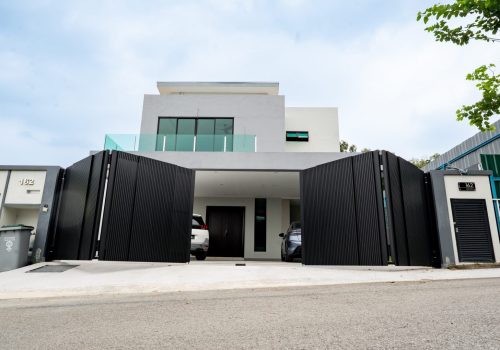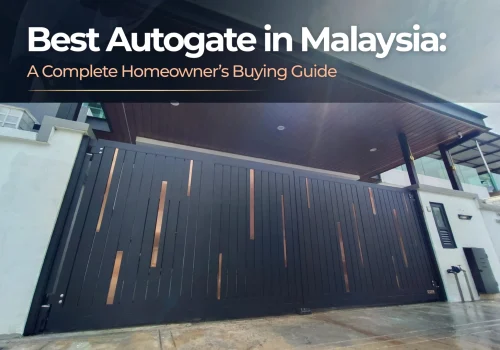
Trackless Autogate in Malaysia: How to Choose the Right Type for Your House
Most homeowners start with the design. When the gate arrives, and the problem shows up.
The panels scrape the driveway. Or the gate swings out into the car parked near the entrance. Or the pillar turns out to be too small for what is now hanging off it.
A trackless autogate removes the floor track. It does not remove the need to match the gate to your entrance.
Key Takeaways
- A trackless autogate carries its weight through the pillar and hinges instead of a track fixed into your driveway.
- Entrance width tells you which systems are available to you. It does not tell you which one to take.
- Gates over 15 feet need a larger reinforced concrete pillar than most homeowners assume.
- Where more than one system fits, the difference is specification — turning points, bearing count, warranty and which designs you can choose from.
- If the ground outside your gate slopes or sits uneven, a gate that folds outwards will scrape or jam.
- Gates that fold inwards suit homes where cars park close to the entrance.
Table of Contents
- What Makes a Trackless Autogate Different From a Track Gate?
- Start With Your Entrance Width
- What Size Should Your Pillar Be?
- Check the Ground Outside Your Gate
- Ask Where Your Cars Actually Park
- Which Type Suits Terrace, Semi-D and Bungalow?
- When More Than One System Fits, What Decides It?
- What Holds the Gate Up Matters More Than the Design
- Which Delux UniGate System Fits Your Entrance?
- Why Homeowners Choose Delux UniGate
- Not Sure Which System Fits Your Entrance?
- FAQs
What Makes a Trackless Autogate Different From a Track Gate?
A conventional folding gate runs on a track set into the driveway. A trackless autogate does not.
The weight transfers to the pillar and the hinge system instead. That changes several practical things:
- Nothing collects sand, leaves or rainwater, because there is no channel
- No track line to crack, patch or re-cement later
- The gate can work on ground that is not perfectly level
- The full load now sits on the pillar and the hinges
The last point is the one most homeowners never hear about. It is also the one that causes problems three or four years later.
Start With Your Entrance Width
Before looking at a single design, measure the gap between your two pillars.
Width is the first filter. It tells you which systems can cover your opening:
- Under 14 feet — a gate that folds to one side is usually the practical answer
- 14 to 20 feet — most configurations are open to you, including entry-level
- 20 to 30 feet — several systems cover this range at different specifications
- Above 30 feet — fewer systems reach this width, and panel length becomes a real consideration
Long panels swing wide. They need more clearance and put more stress on every hinge. 6 shorter panels with more turning points fold into a much smaller footprint than 4 long ones.
Delux designs UniGate across seven configurations covering 5 feet up to 40 feet. Width tells you which configurations are open to you. It does not tell you which one to take.
What Size Should Your Pillar Be?
This is the part most homeowners never think about until the gate is already up.
A trackless gate transfers its full weight into the pillar. If the pillar is undersized, no bracket and no hinge will save it. The gate still works, but the pillar starts showing hairline cracks, and the gate slowly stops closing flush.
As a general guide for reinforced concrete pillars:
- Gates 15 feet and under — a 1ft x 1ft RC pillar is the minimum
- Gates over 15 feet — 1.5ft x 1.5ft RC pillar is strongly recommended
- Gates over 30 feet — have it assessed on site before you commit to a design
Above 30 feet, pillar size alone is not enough to go on. Panel weight, how the gate folds, ground condition and how the pillar was originally built all come into it.
If your pillar is already standing, check the base for existing cracks before anything is mounted to it. A crack that is already there means the pillar needs attention first, whatever gate you end up choosing.
Undersized pillars are one of the more common issues our consultants come across on site. A gate can hang on a pillar that is too small for it and still open and close normally at first. The crack at the base tends to appear a year or two later, and by then reinforcing the pillar costs considerably more than casting it correctly would have.
So if you are still at the renovation stage, raise this with your contractor now.
Check the Ground Outside Your Gate
Stand outside your gate and look down.
If the ground slopes, drops toward the road, or sits unevenly, a gate that folds outwards will bind or scrape. This is common in older housing areas and on corner lots.
Two situations to watch:
- The ground outside slopes downward — the gate needs bottom clearance, or it catches as it opens
- Your interior ground sits lower than the entrance — a gate that folds inwards handles this far better

For factories and commercial units where floor condition is unpredictable, a sliding system avoids the problem completely. The gate never travels over the ground.
Ask Where Your Cars Actually Park
This is the question that gets skipped most often.
If you park close to the gate, an outward-folding gate needs clear space in front of it every single time it opens.
A gate that folds inwards, with the motor mounted on the inside, opens without sweeping across your porch.
On terrace houses with two cars, the second one is often parked just inside the gate. With an outward-folding gate, that means moving a car before the gate can open properly. It is one of the more common reasons homeowners end up on an in-folding system rather than the design they first had in mind.
Before deciding, ask yourself:
- Where does the second car park when everyone is home?
- Is there a drain, kerb or slope directly in front of the gate?
- Is your house near a main road where an outward swing becomes a hazard?
Which Type Suits Terrace, Semi-D and Bungalow?
These are patterns, not rules. Your entrance still needs measuring.
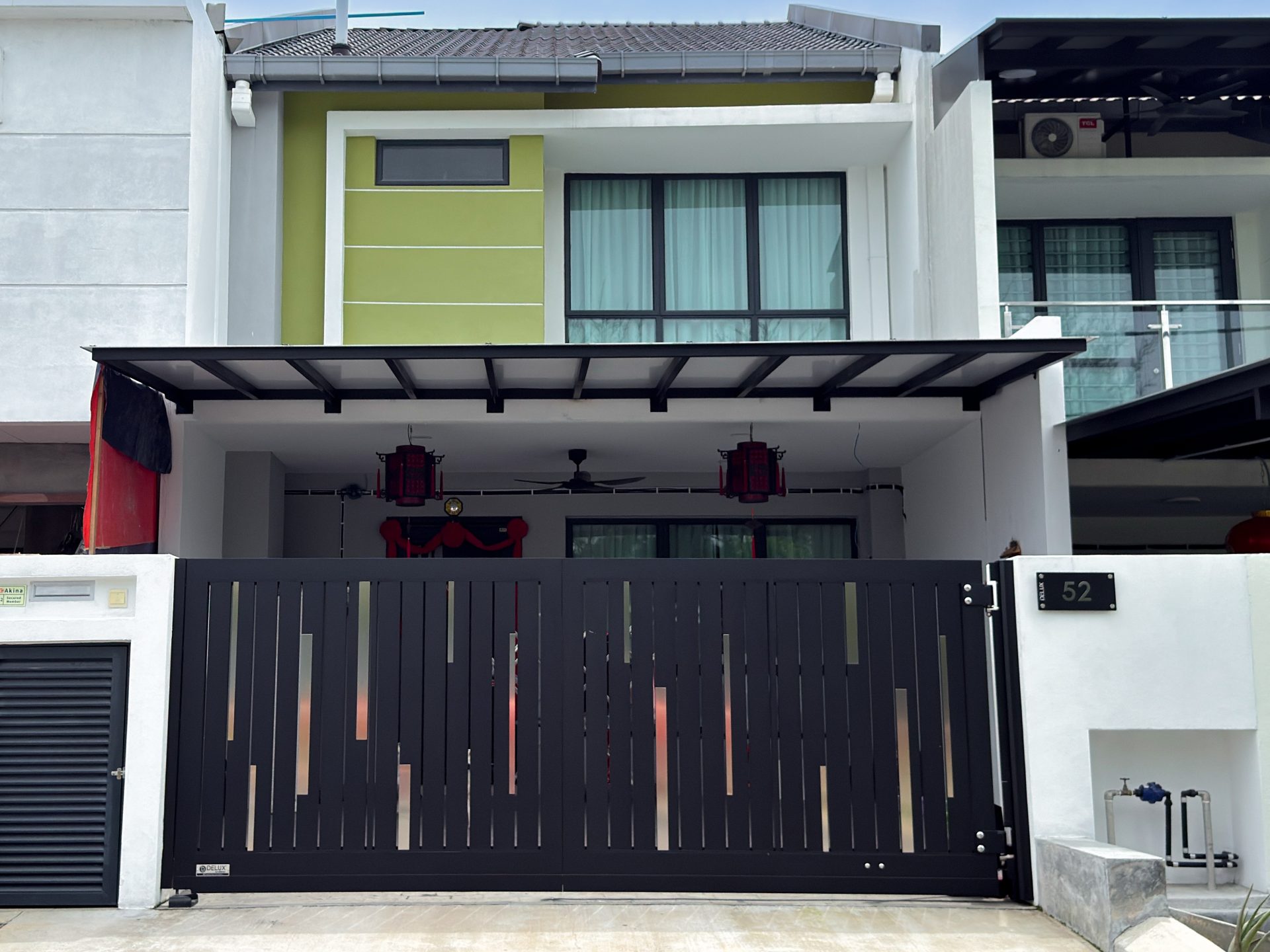
- Terrace house — usually 14 to 20 feet. Space is tight, so folding inwards or to one side keeps the porch usable.
- Corner lot or end lot — often shorter or angled. A gate that stacks to one side works well.
- Semi-detached — typically 20 to 30 feet. Several systems cover this range.
- Bungalow — 30 feet and above. Fewer systems reach this width.
- Factory or commercial — floor conditions vary too much to predict. A sliding trackless system is the safer choice.
When More Than One System Fits, What Decides It?
Width usually leaves you with two or three options. What separates them is not size. It is a specification.
A 20-foot entrance can take UniGate Plus or UniGate Pro. Both cover the width. What differs is everything behind it:
- Number of turning points. More turning points let the gate fold into a smaller footprint and spread movement across more joints, rather than loading a few.
- Bearing count. UniGate configurations carry from 20 to 68 bearings. More bearings means less load at each point, and a gate that stays quiet for longer.
- Material thickness. Higher systems use thicker material, which resists flexing. That is what keeps a wide gate closing flush after years of daily use.
- Warranty length. Base and Plus carry up to 5 years. Pro, Ultra-Fold, In-Fold, Single Fold and Slide carry up to 10 years.
- Which designs you can choose from. Certain designs are only available on higher systems. Gates with integrated LED lighting, for example, can only be built on Pro.
That last point catches people out. Homeowners often settle on a design first, then find it does not come on the system they had budgeted for. If a particular look matters to you, check which system carries it before you fix a budget.
Cycle count is worth thinking about too. A gate opening eight times a day accumulates wear far faster than one opening twice.
UniGate has been tested by SIRIM to 50,000 opening cycles. At six cycles a day, that works out to over twenty years of use. At ten cycles a day, more than thirteen.
Ask any supplier whether their gate has been cycle-tested, and by whom. Most cannot answer.
What Holds the Gate Up Matters More Than the Design
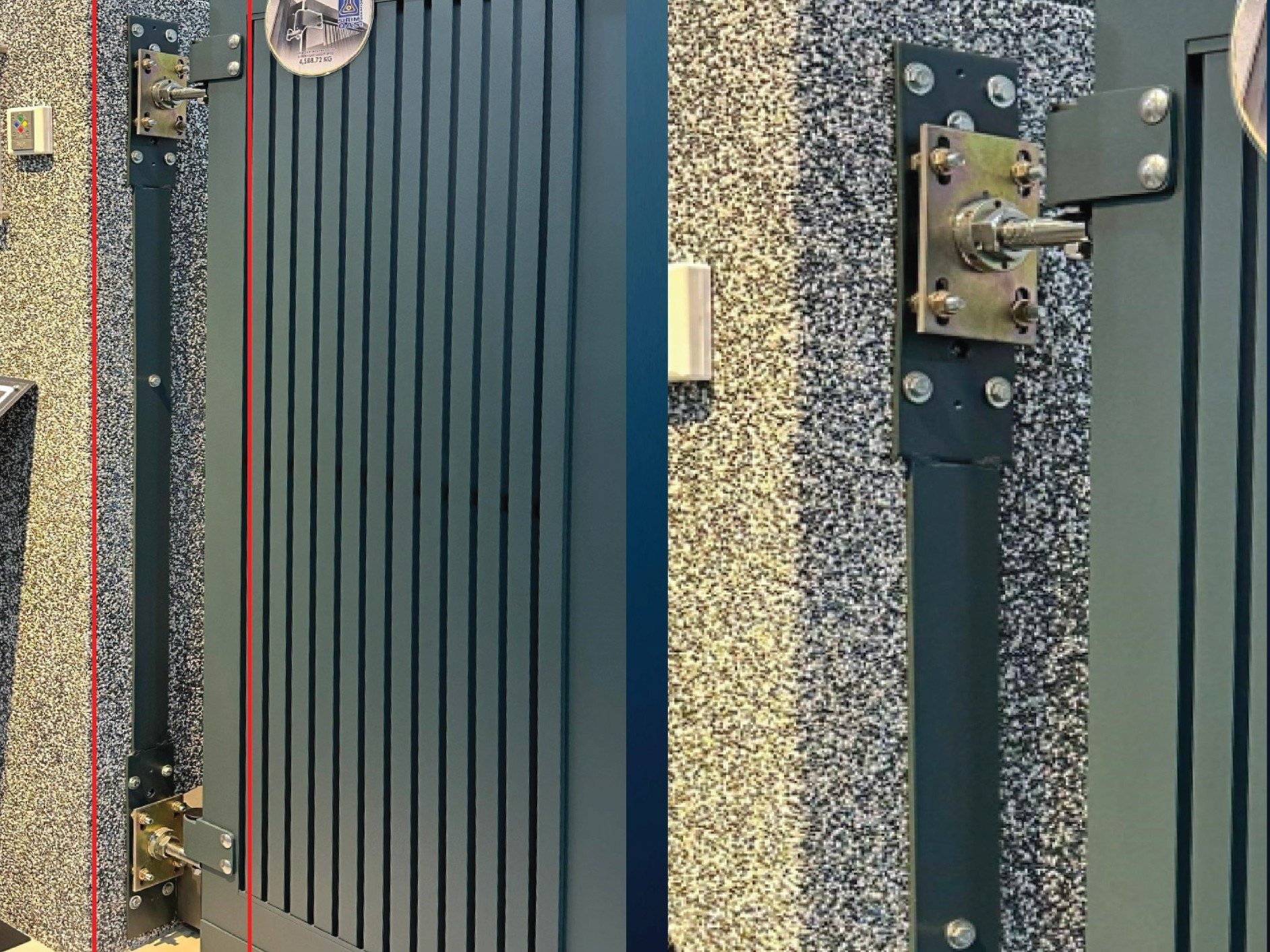
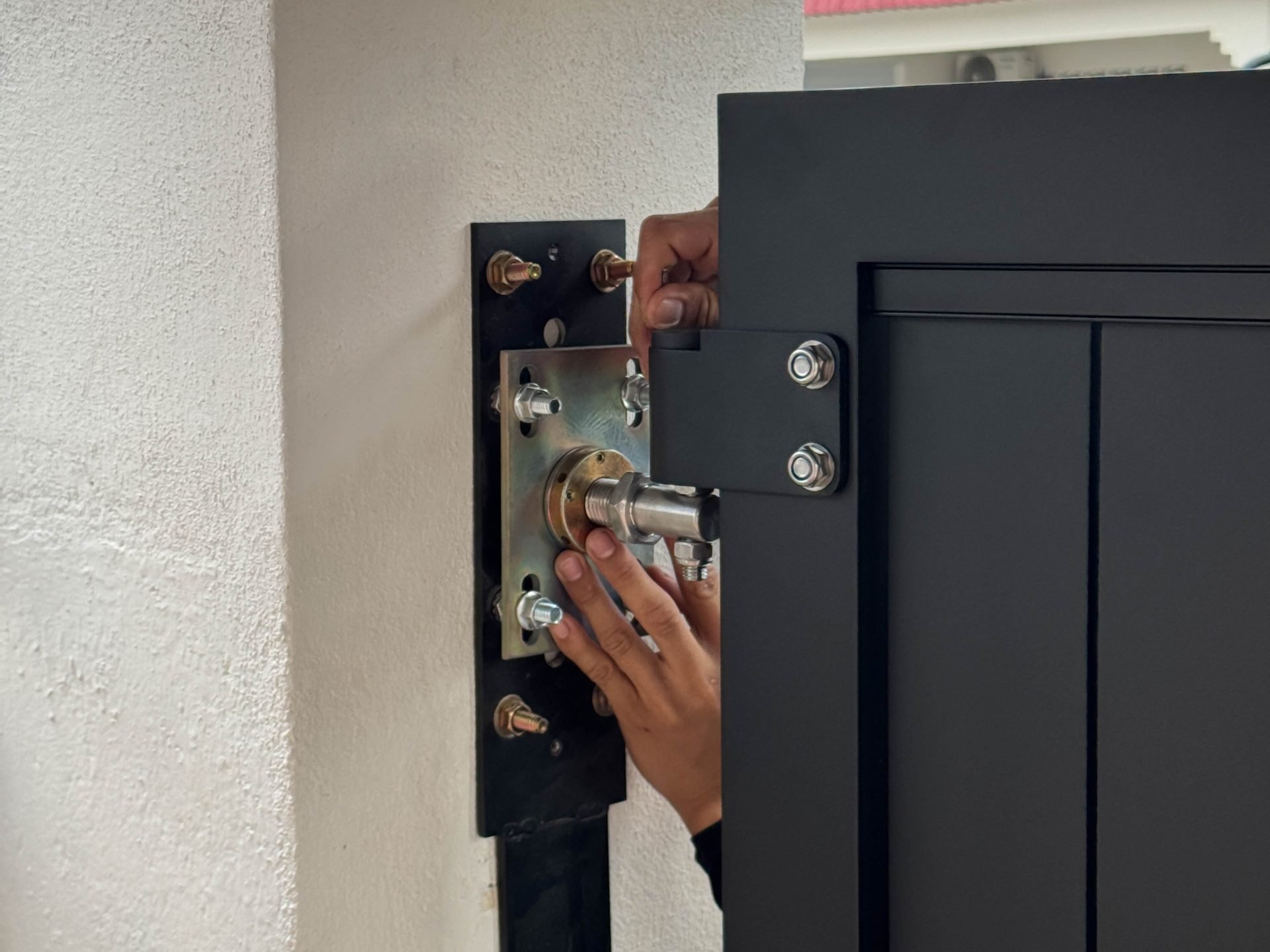
With no floor track, the pillar and the mounting bracket take everything.
A heavy gate fixed at two or three points concentrates that load into a small area. Over time it shows as hairline cracks in the pillar, or a gate that no longer closes flush.
Four things to check on any quotation:
- How many points the bracket spreads the load across. UniGate is specified with a wall support system that distributes weight across twelve points instead of concentrating it.
- What the bearings are made of. Copper and stainless steel resist rust in Malaysian humidity far better than standard steel. UniGate is specified with up to 68 ball-less copper and stainless steel bearings.
- Whether the hinges can be adjusted later. Delux’s 360° adjustable hinge has undergone compression load testing by SIRIM, and lets misalignment or a gap be corrected on site instead of dismantling the gate.
- The rated load capacity, and where the rating comes from. Delux is recognised by the Malaysia Book of Records for the highest load-bearing trackless autogate at 4,588kg.
A gate that can be realigned in an hour, five years from now, will cost you far less than one that cannot.
Which Delux UniGate System Fits Your Entrance?
Seven configurations. Width tells you which are open to you, specification tells you which to take.
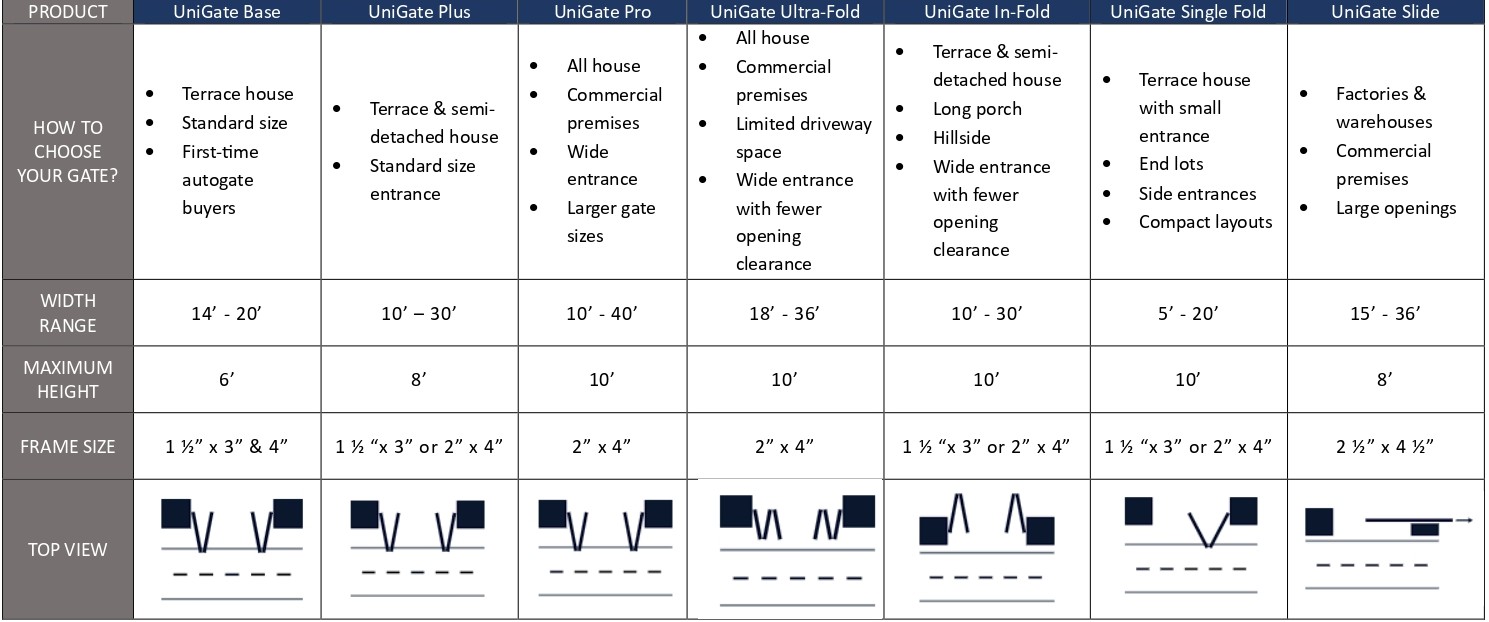
- UniGate Base — 14′ x 6′ to 20′ x 6′. Entry-level, more privacy. 4 panels, 2 turning points, 20 bearings. Warranty up to 5 years.
- UniGate Plus — up to 30′ x 7′. 4 panels, 24 bearings. Warranty up to 5 years.
- UniGate Pro — up to 40′ x 10′. 4 panels, 3 turning points, 30 bearings. Panels open beyond 100°. The widest design range, including designs not available on other systems. Warranty up to 10 years.
- UniGate Ultra-Fold — up to 36′ x 10′. 6 shorter panels, 7 turning points, 68 bearings. Space-saving fold for large entrances and houses near a roadway. Warranty up to 10 years.
- UniGate In-Fold — up to 30′ x 10′. 4 panels, 4 turning points, 30 bearings. Folds inwards with the motor installed inside, for lower interior ground and cars parked near the entrance. Warranty up to 10 years.
- UniGate Single Fold — up to 20′ x 10′. 2 or 3 panels folding to one side. For corner units, end lots and smaller entrances. Warranty up to 10 years.
- UniGate Slide — up to 36′ x 8′. Sliding system with an Italian motor and reverse safety sensor. For factories, warehouses and any floor condition. Warranty up to 10 years.
Why Homeowners Choose Delux UniGate?
- Seven configurations across specification levels: From 5 feet to 40 feet, with entry-level through to 10-year systems, so you choose the level rather than the only thing that fits.
- Over 1,250 designs: Including designs available only on higher systems.
- Patented D-Trinology triple protection: A patented arm lock, anti-force latch and secure stopper working together against forced entry.
- 12-point wall support with 360° adjustable hinges: Weight is distributed rather than concentrated to protect your pillar, and alignment can be corrected on site without dismantling the gate.
- Tested by SIRIM: UniGate has been tested to 50,000 opening cycles, and the 360° adjustable hinge has undergone compression load testing.
- Verified by the Malaysia Book of Records: Five entries, including 4,588kg load capacity and the longest trackless autogate at 40 feet. These figures are certified, not claimed.

Not Sure Which System Fits Your Entrance?
Choosing a trackless autogate happens in two steps. Measure first, to see which systems cover your opening and whether your pillar can carry them. Then compare specifications to decide which of them you want.
Most people do it in the opposite order, choose a design, and find out later that it only comes on a system they had not budgeted for.
Visit a Delux showroom or arrange a site measurement with a certified Delux partner. You will see which systems fit your entrance, what your pillar can take, and which designs come with each.
FAQs
1. How much does an autogate cost in Malaysia?
Autogate cost varies with entrance width, the system specification you choose, the design, the motor and the mounting system. Ask for a quotation that states the exact size, system, panel count and what is included, so you can compare options on the same terms rather than on price alone.
2. What size pillar do I need for a trackless autogate?
As a general guide, gates up to 15 feet need at least a 1ft x 1ft reinforced concrete pillar, and gates over 15 feet are better on 1.5ft x 1.5ft. Above 30 feet, the pillar should be assessed on site, because panel weight, folding type and how the pillar was built all affect what it needs to carry.
3. Two systems fit my entrance. How do I choose between them?
When more than one system covers your width, the difference is specification rather than size. Compare turning points, bearing count, material thickness and warranty length. Also check which designs each system carries, because some designs are only available on higher systems.
4. How long does a trackless autogate last?
Service life depends on how often the gate is used and how well the load is carried. UniGate has been tested by SIRIM to 50,000 opening cycles, which works out to more than twenty years at six openings a day. Ask any supplier whether their gate has been cycle-tested, and to how many cycles.
5. Is a trackless autogate suitable for a terrace house?
Yes. Most terrace entrances fall between 14 and 20 feet, which nearly every configuration covers. For a short porch, a gate that folds inwards or to one side usually preserves more usable space.
6. Does a trackless autogate work on sloped or uneven ground?
Usually yes, but the type matters. A gate folding outwards over a downward slope needs bottom clearance, and an in-folding or sliding system is often the better answer. The ground should be checked on site first.