How to Choose the Right Security Door for Your Home in Malaysia (Aluminium vs Other Materials)
Most homeowners only start thinking seriously about a security door after two things happen: they hear about a break-in nearby, or they notice their current grille door has started rusting, sagging, or attracting termites at the frame. By then, the choice usually gets made in a rush — whichever door the nearest workshop can install fastest.
That’s a problem, because a security door isn’t a small purchase. It sits at your main entrance for 10–15 years, takes daily wear from Malaysia’s heat and humidity, and is the one thing standing between your home and an intruder. Picking the wrong material means repainting, rust removal, or even a full replacement within a few years — while picking the wrong locking system can leave you exposed no matter how solid the door looks.
This guide breaks down how the common security door materials in Malaysia actually perform over time, what to check before you buy, and where a full-aluminium option like DELUX AlutechDoor Flex fits in if you’d rather not deal with a hacking job just to get a door installed.
Key Takeaways
- Malaysia’s year-round humidity makes rust and termite damage two of the biggest long-term threats to a security door — not just break-ins.
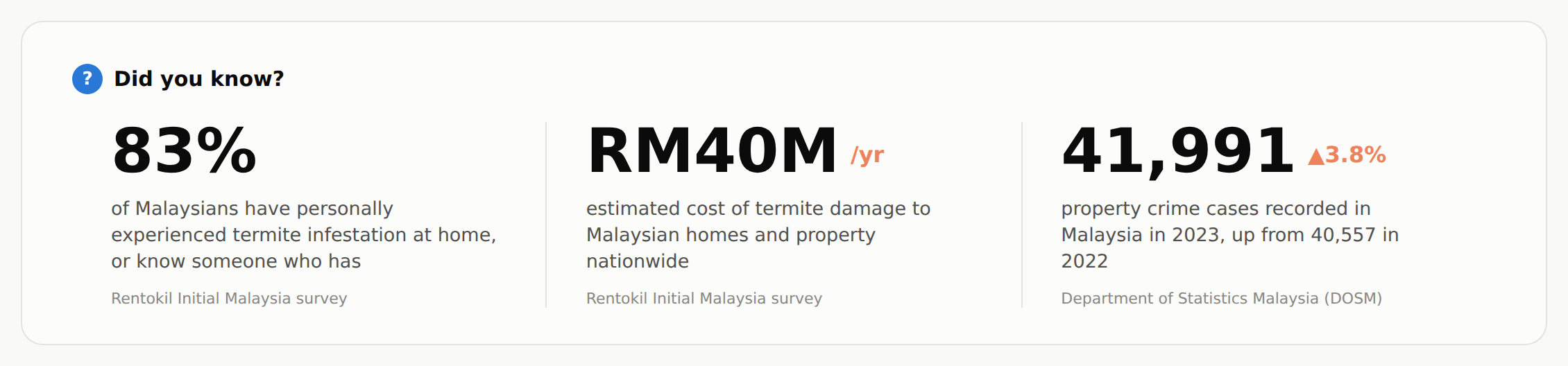
- Property crime cases in Malaysia rose to 41,991 in 2023, a 3.8% increase from the year before, making a strong door lock system as important as the material itself.
- Wrought iron and mild steel doors are affordable upfront but need repainting and rust treatment every few years; wood needs regular termite protection; full aluminium doors avoid both problems entirely.
- 83% of Malaysians say they’ve personally experienced termite infestation at home or know someone who has — a risk that timber-based doors and frames are directly exposed to.
- A good security door should balance durability against Malaysia’s climate, a reliable locking mechanism, and an installation that doesn’t tear up your home — full aluminium doors like DELUX AlutechDoor Flex are built to install directly onto your existing structure, with no hacking required.
- DELUX AlutechDoor Flex is designed to fit both new and existing homes without a renovation-scale job — installation typically takes around 3 hours, and it’s compatible with over 90% of homes as-is.
Why the Security Door Material Matters in Malaysia’s Climate
Malaysia’s relative humidity typically sits between 70% and 90% in most urban areas year-round, with some regions ranging as wide as 10–90% depending on location and season, according to the Malaysian Meteorological Department (MetMalaysia). Combined with heavy rainfall for much of the year, this creates near-constant moisture exposure at your main entrance — one of the most weather-exposed parts of any home.
Two consequences follow directly from this:
- Metal doors without proper coating rust. Mild steel and standard wrought iron grilles are prone to surface rust within a few years if the paint layer is scratched or worn, especially at welded joints where coating tends to be thinnest.
- Timber doors and frames are exposed to termites. According to a nationwide Rentokil Initial Malaysia survey, 83% of Malaysians have personally experienced termite infestation at home or know someone who has, and termite damage is estimated to cost Malaysian households and property owners around RM40 million a year. Homeowners who did have to treat an infestation reported spending RM3,000–RM5,000 on treatment alone.
On top of climate wear, there’s the security question itself. Property crime cases in Malaysia rose to 41,991 in 2023 — up 3.8% from 40,557 cases in 2022, per the Department of Statistics Malaysia (DOSM). A security door is meant to reduce that risk, but a door that’s already weakened by rust or rot at the frame is far easier to force open than one that’s still structurally sound.
In other words: in Malaysia, “durable” and “secure” aren’t two separate features — a door that degrades faster also becomes less secure over time.
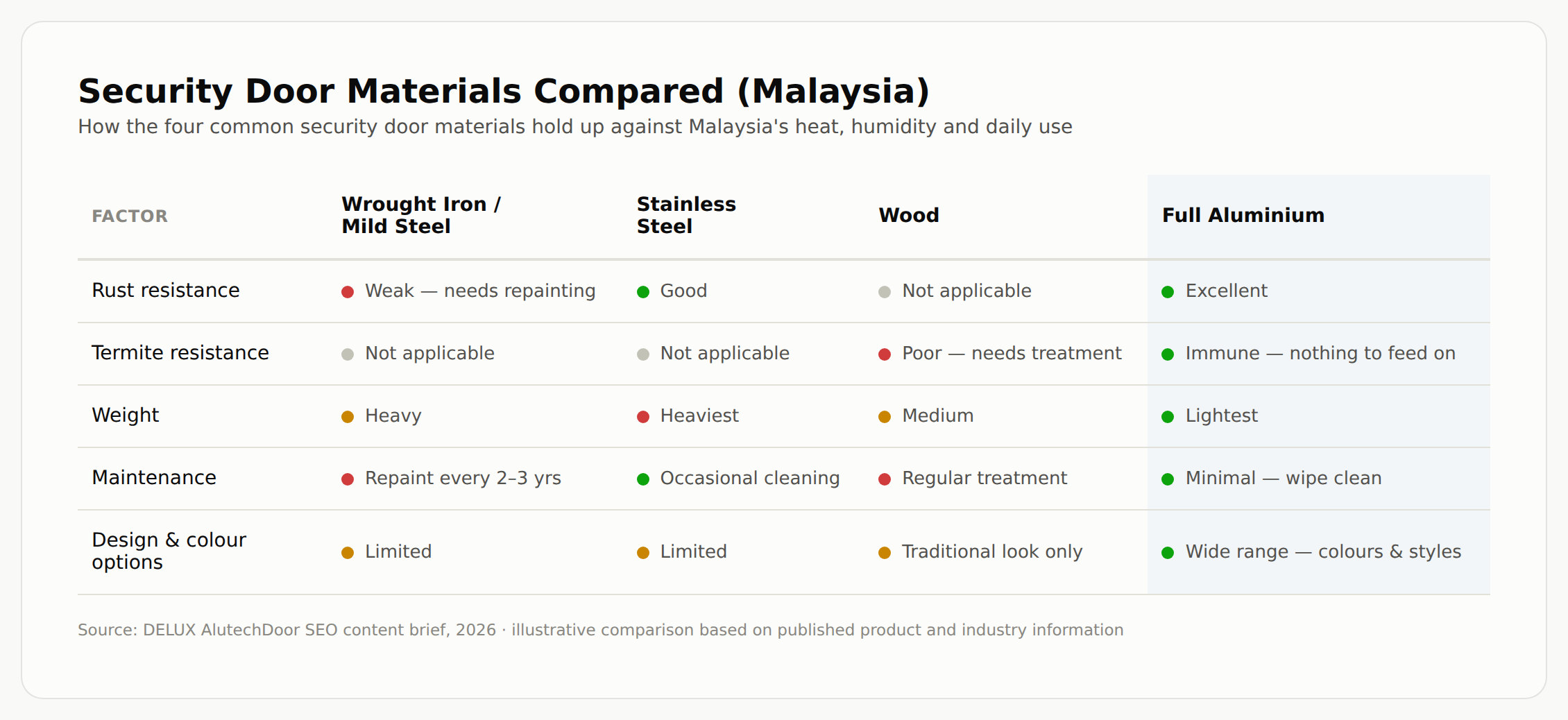
Comparing Security Door Materials in Malaysia
1. Wrought Iron / Mild Steel
The most common option in landed housing estates, largely because it’s the cheapest to install upfront. Downsides show up over time: paint chips, rust spots appear (especially near welded joints and screw points), and repainting is usually needed every 2–3 years to keep it looking presentable. Welded joints are also a common weak point — once rust sets in there, the structural strength of the door can be compromised.
2. Stainless Steel
More rust-resistant than mild steel and generally sturdier, but it comes at a higher price point and is noticeably heavier — which puts more strain on hinges over time and can make daily use (especially for elderly family members) less convenient. Design options also tend to be more limited than other materials.
3. Wood / Timber
Wood offers a warmer, more traditional look, but it’s the material most exposed to Malaysia’s climate risks. It requires regular staining or varnishing to prevent warping from humidity, and — as covered above — is a direct target for termite infestation if not properly treated and monitored.
4. Full Aluminium
Aluminium naturally resists rust and corrosion, doesn’t attract termites at all (there’s simply nothing for them to feed on), and is significantly lighter than steel — which means less strain on hinges and smoother daily operation. Modern full-aluminium doors also tend to come in a wider range of designs, since aluminium panels can be powder-coated in more colour options and finished in a wider range of styles than a welded steel frame.
Did You Know?
Because aluminium doesn’t corrode or feed pests, homes near the coast or in high-humidity areas (which describes most of Malaysia) tend to see the biggest long-term maintenance savings by switching from steel or wood to aluminium — the upfront price difference is usually recovered through skipped repainting and pest treatment costs over the door’s lifespan.
What to Look For Before You Buy a Security Door
Material is only half the decision. Before you commit, check:
- Locking mechanism – Look for anti-break-in locking systems, not just a standard latch. Multi-point locking or a reinforced clamping system is harder to force open than a single-point lock.
- Joint construction – Welded joints can weaken over time (especially with rust). Clamped or bolted construction avoids that specific failure point.
- Thickness and frame strength – A thin panel may look similar in photos but flex or dent far more easily in person.
- Finish and coating – Powder-coating should be even and factory-applied, not touched up on site.
- Design & colour options – Does the brand offer a wide range of colours and panel styles to choose from, or are you limited to a handful of standard templates?
- Installation method – Does it require hacking (breaking) your existing wall, floor, or frame to fit, or can it be installed directly onto what’s already there? A no-hacking installation usually means less mess, less time, and no structural repair work afterward.
- Warranty and after-sales support – Ask specifically what’s covered (structural defects vs. finish/coating) and for how long.
Introducing DELUX AlutechDoor Flex — Security Without the Hacking Job
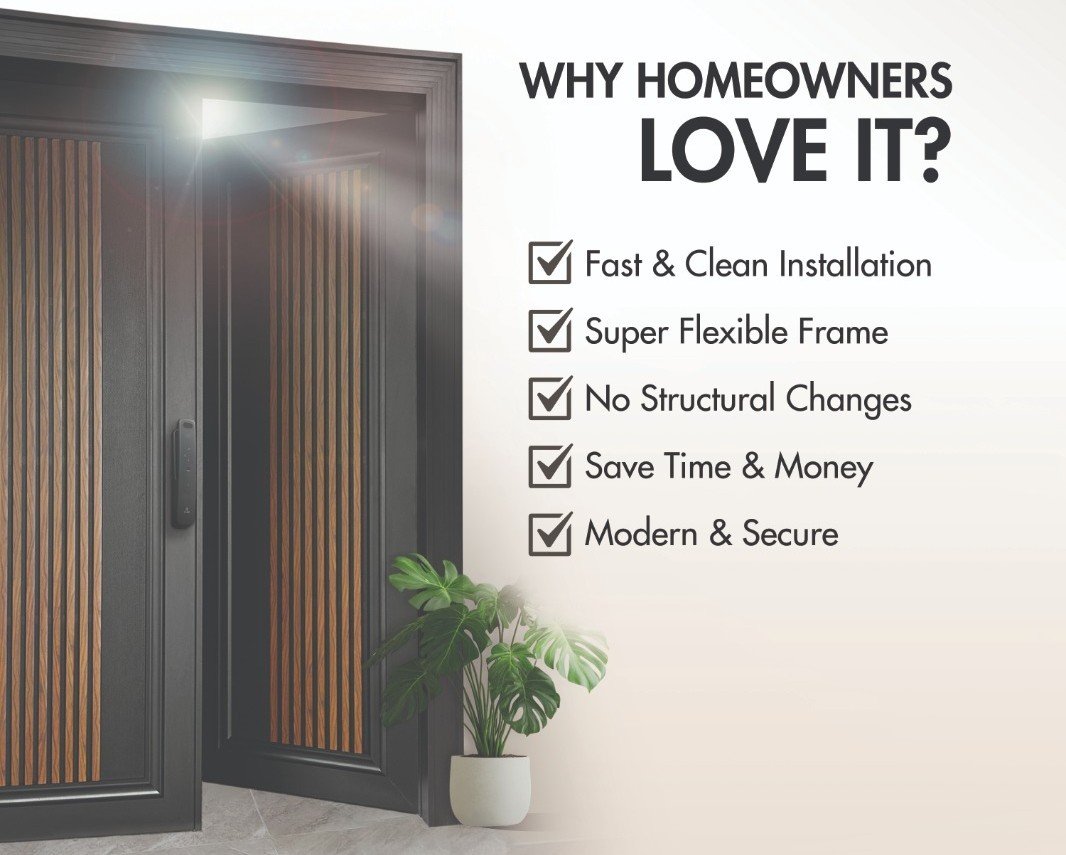
Most of the trade-offs above — rust vs. cost, security vs. installation hassle — come from the material and construction method a door is built on. DELUX AlutechDoor was engineered specifically to remove that trade-off: a fully aluminium security door built with the Alubotic® anti-break-in locking system, using a clamped (not welded) frame construction, finished in a premium powder-coated matt finish that resists rust and is completely termite-proof. DELUX AlutechDoor is recognised in the Malaysia Book of Records as the first certified fully aluminium security door in Malaysia (2022).
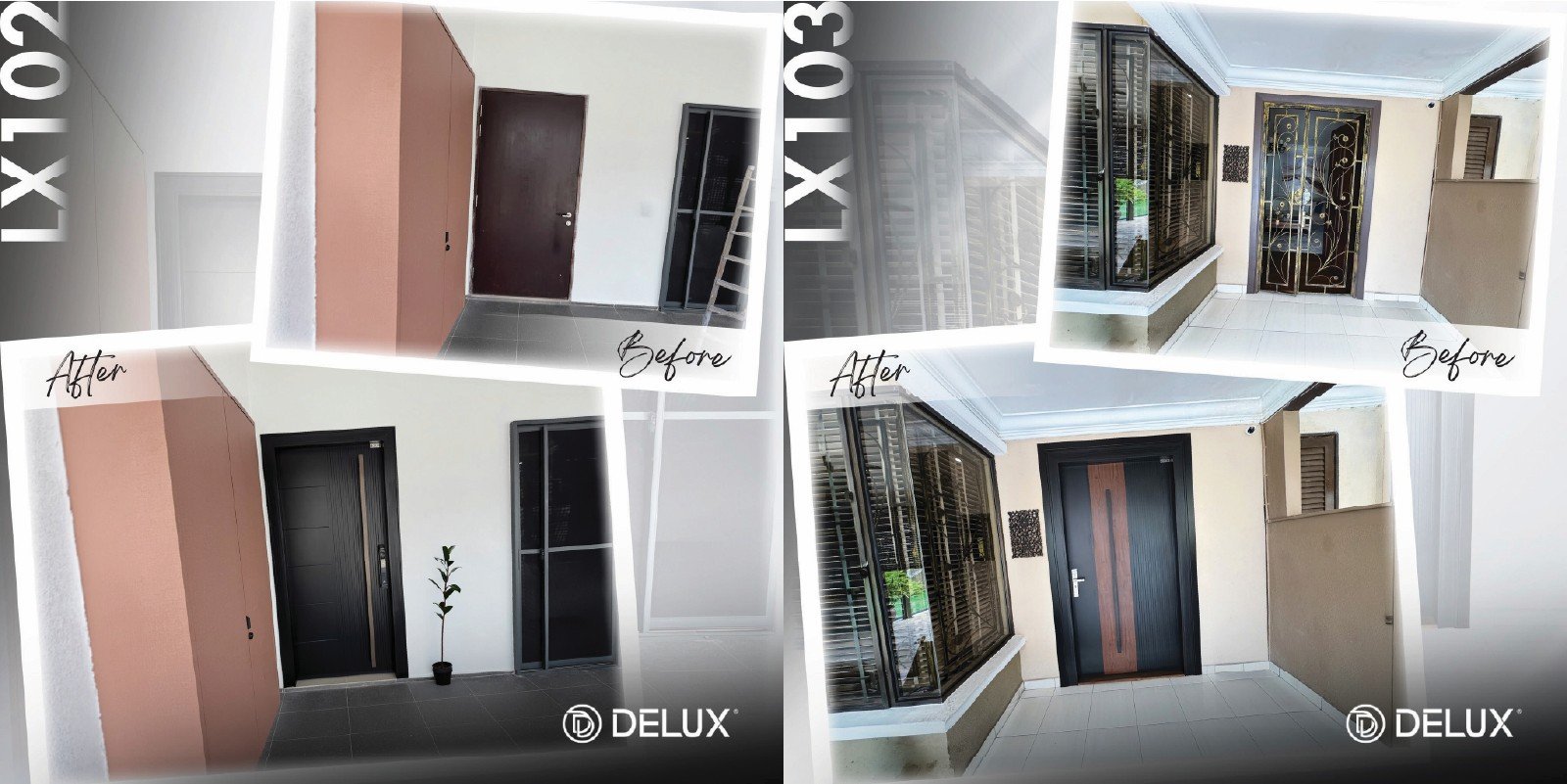
AlutechDoor Flex is the line built for a direct, no-hacking installation — it fits onto your existing door frame or structure without needing to break down brickwork, repaint, or replace floor tiles first. That’s the difference from a traditional security door replacement, which usually means hacking out the old frame, patching and repainting the wall, sometimes redoing the floor tiles at the threshold, and living with a renovation-length job just to get a new door.
AlutechDoor Flex is built for exactly the homeowner who wants better security at the front door without signing up for that — whether it’s an older home where the existing grille has started rusting, or a new home where you simply don’t want to deal with renovation works. Installation typically takes around 3 hours, and it’s compatible with over 90% of homes as they are. Because every home’s existing structure is a little different, DELUX offers an on-site consultation to confirm a home is a fit before installation.
Choosing the Right Security Door for Your Home
There’s no single “best” security door material — there’s the one that fits your climate exposure, your budget, and how much you care about matching your home’s design. But in Malaysia specifically, the two biggest long-term risks (rust from humidity, and termite damage) both point in the same direction: away from untreated steel and timber, and toward full aluminium construction.
If you want a door that holds up structurally for over a decade without repainting or pest treatment — and don’t want a hacking job just to get it installed — a full aluminium, no-hacking option like AlutechDoor Flex is worth shortlisting before you decide.
FAQs
1. Is aluminium better than wrought iron for security doors in Malaysia? For long-term durability, yes — aluminium doesn’t rust the way mild steel and wrought iron can, especially at welded joints, and needs far less maintenance over the door’s lifespan in Malaysia’s humid climate. Wrought iron can still be a reasonable choice if upfront cost is the main priority and you’re prepared for repainting every few years.
2. Does an aluminium security door rust in humid weather? No. Aluminium naturally forms a protective oxide layer and doesn’t rust the way iron-based metals do, which is why it holds up well even in Malaysia’s high-humidity, high-rainfall climate.
3. How much does a security door cost in Malaysia? Cost varies by material, size, and locking system — wrought iron doors are typically the most affordable upfront, while stainless steel and full aluminium doors sit at a higher price point. For a no-hacking option like AlutechDoor Flex, pricing is quoted per home after an on-site assessment (every door frame and structure is slightly different), but it’s worth weighing against the full cost of a traditional door replacement — hacking, repainting, and often re-tiling the floor — which usually adds up to more than the door itself once the renovation work is factored in.
4. Can a security door be installed without hacking my wall or door frame? Yes — some full aluminium security doors, like DELUX AlutechDoor Flex, are built to install directly onto your existing structure without hacking (breaking) the wall, floor, or frame. That cuts out the dust, mess, repainting, and follow-up patch-up work that comes with a traditional built-in installation — AlutechDoor Flex, for example, typically takes around 3 hours to install.
5. How long does an aluminium security door last? Because aluminium doesn’t rust or attract termites, a well-built full aluminium security door can last well beyond 10–15 years with minimal maintenance, compared to steel or timber doors that typically need repainting, rust treatment, or pest control at regular intervals over the same period.
6. Will a no-hacking security door fit any home? Most homes can — DELUX AlutechDoor Flex is compatible with over 90% of homes as they are, whether the home is new or older with an existing grille door already in place. Because every home’s door frame and structure is slightly different, DELUX offers an on-site consultation to confirm your home is a fit before installation.